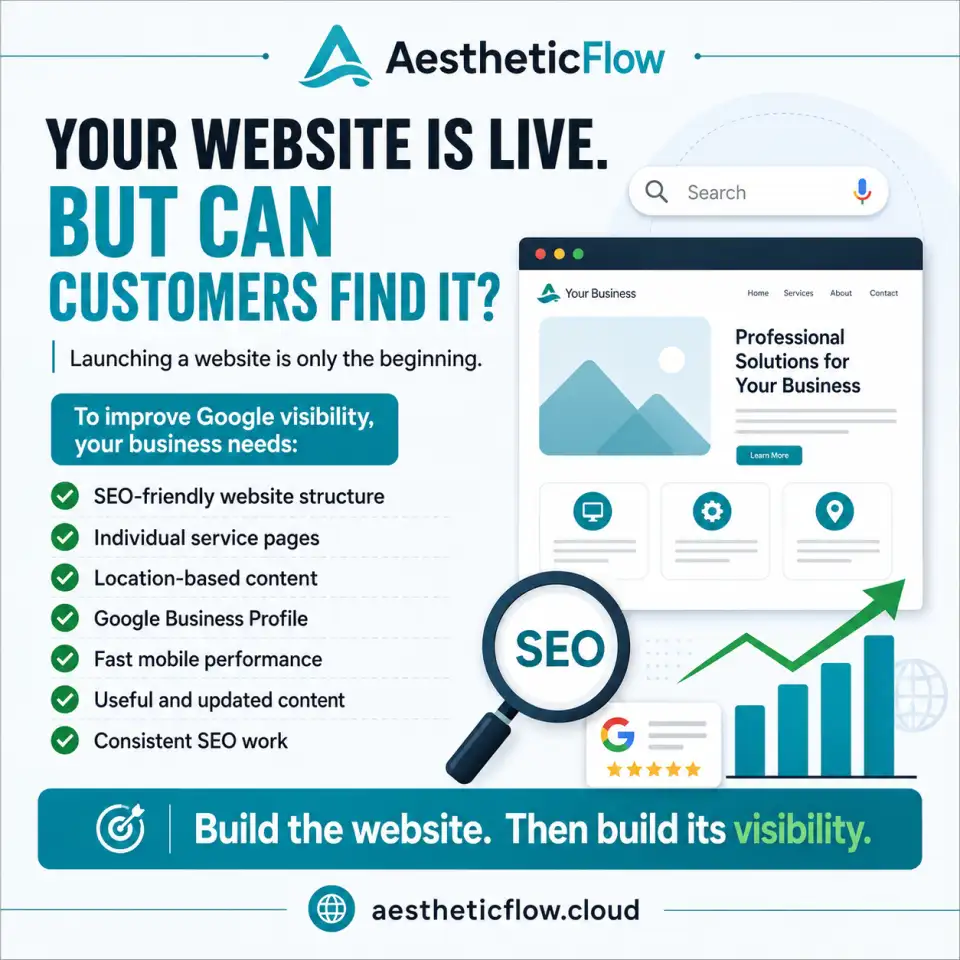
Launching a professional website is an important step for any modern business. It gives potential customers a place to learn about your services, view your work, understand your brand and contact you.
However, creating a website does not automatically place it at the top of Google.
A website and Google ranking are connected, but they are not the same thing. Your website creates the foundation. Search engine optimisation, useful content, business credibility and ongoing improvement help Google understand when and where the website should appear.
Google explains that SEO helps search engines understand your content and helps users find your website through search results. You can read more in the official Google SEO Starter Guide.
What Happens After a Website Is Launched?
After launch, search engines must discover, crawl and index the website.
Indexing means Google has discovered the page and may include it in search results.
Ranking refers to the position where that page appears when someone searches for a particular keyword or phrase.
A page may be indexed without ranking prominently for competitive searches.
For example, a salon website may appear when someone searches for its exact business name but remain difficult to find for broader searches such as:
- Ladies’ salon in Islamabad
- Bridal makeup artist near me
- Hair treatment in Gulberg Greens
- Beauty salon in Rawalpindi
Ranking for these searches usually requires much more than simply putting a website online.
Why Does a New Website Not Immediately Rank?
1. Google Needs to Understand the Business
Your website must clearly explain:
- What your business offers
- Where the business operates
- Which customers it serves
- Why its services are relevant
- How visitors can contact or book
A website with vague, copied or limited information gives search engines fewer useful signals.
Your main heading, service descriptions, location information and page structure should make the purpose of the business clear to both visitors and search engines.
2. Each Important Service Needs Proper Coverage
Listing every service on one general page may not be enough.
A business offering bridal makeup, hair colour, facials and nail services should consider dedicated pages for its most important services.
These pages allow the business to explain each service properly and target more relevant searches.
For example:
/services/bridal-makeup-islamabad
/services/hair-colour-gulberg-greens
/services/hydrafacial-bahria-town
Each page should provide genuinely useful information instead of repeating the same keywords with only minor changes.
A strong service page may include:
- A clear service explanation
- Benefits and suitable customers
- Prices or starting prices
- Frequently asked questions
- Real photographs
- Reviews or results
- Location details
- A booking, call or WhatsApp option
3. Local Information Matters
Local businesses should clearly display consistent information, including:
- Business name
- Address or service area
- Phone number
- Opening hours
- Location details
- Google Map
- Areas served
This information should remain consistent across the website, Google Business Profile and relevant business directories.
Google states that complete and accurate business information can help a business appear in relevant local search results. See Google’s official guidance on improving local ranking.
4. Competition Affects the Timeline
A new business website may be competing against websites that have existed for years.
Established competitors may already have:
- Large amounts of useful content
- Strong business reputations
- Many customer reviews
- Relevant links from other websites
- Established Google Business Profiles
- Regularly updated service pages
- Consistent SEO work
A new website must gradually establish relevance, authority and trust.
This does not mean a new website cannot compete. It means the business needs a realistic strategy rather than expecting immediate top positions.
5. Website Quality Affects Visibility
Google visibility is influenced by the overall website experience.
A business website should be:
- Mobile-friendly
- Fast loading
- Secure
- Easy to navigate
- Clear and readable
- Free from broken links
- Structured logically
- Designed around customer intent
- Easy to contact from
- Helpful rather than repetitive
A visually attractive website can still perform poorly if it is slow, confusing or difficult to use on mobile devices.
What Is the Difference Between Indexing and Ranking?
These terms are often confused.
Indexing
Indexing means Google has stored information about a page in its search index and the page may be eligible to appear in search results.
Ranking
Ranking means Google has selected a position for that page when someone searches for a particular phrase.
A website can therefore be indexed but still appear far below established competitors.
A business may also rank differently for different searches.
For example:
- It may rank well for its exact business name.
- It may rank lower for a general service.
- It may rank differently in Islamabad and Rawalpindi.
- It may appear in Google Maps but not in the main organic results.
- One service page may perform better than another.
Google’s guide to how Google Search works explains the broader crawling, indexing and ranking process.
How Long Can Google Ranking Take?
There is no guaranteed ranking timeline.
Results depend on factors such as:
- Competition
- Website history
- Technical quality
- Content depth
- Service location
- Business reputation
- Search demand
- Google Business Profile strength
- Website authority
- Quality of ongoing SEO work
Some pages may begin appearing relatively early for specific, lower-competition searches. More competitive keywords can require several months or longer.
For example, ranking for a branded search such as Fayna’s Beauty Studio in Gulberg Greens may be easier than ranking for a broad search such as: Best ladies’ salon in Islamabad
The branded search is more specific, while the broader keyword may include many established competitors.
The same principle applies to other businesses. A specific search for Annaliza Estetica may be easier to target than a broad keyword such as: est aesthetic clinic in Rawalpindi
Similarly, a branded search for Face Master Umeh Marium may face less competition than: Best face lifting treatment in Lahore
A search for Afshan Aesthetic Salon may be easier than: Best ladies’ salon in Gulberg Residencia Same for the Stylish Beauty Salon By Azra
A branded search for Hair Studio by Asghar may also be easier to rank for than a broader search such as: Best hair salon in Islamabad
These examples show why businesses should target a combination of:
- Branded keywords
- Service keywords
- Location-based keywords
- Long-tail customer searches
- Google Business Profile visibility
Any company promising a guaranteed first position within a fixed period should be treated carefully because Google ultimately determines organic rankings.
What Should Happen After Website Launch?
1. Submit the Website for Indexing
The website should be connected to Google Search Console.
Its sitemap should also be submitted so Google can discover important pages more efficiently.
A sitemap helps search engines understand which pages the website owner considers important. However, submitting one does not guarantee indexing or ranking.
Google provides an official guide explaining how to build and submit a sitemap.
2. Set Up Analytics and Conversion Tracking
Businesses should track more than visitor numbers.
Useful actions to measure include:
- WhatsApp clicks
- Phone calls
- Contact-form submissions
- Appointment requests
- Product inquiries
- Completed bookings
- Quote requests
- Email clicks
- Direction requests
- Purchases
The real objective is not only website traffic. It is generating meaningful business results.
A website that receives 1,000 irrelevant visitors may be less valuable than a website that receives 100 relevant visitors and generates 10 genuine inquiries.
3. Optimise the Google Business Profile
For local businesses, the Google Business Profile is an important part of local visibility.
It should contain:
- The correct primary category
- Accurate address information
- Updated opening hours
- A working phone number
- The correct website link
- Detailed service descriptions
- High-quality photographs
- Genuine customer reviews
- Regular business updates
- Accurate service areas
Business information should also match the website.
For example, different phone numbers, addresses or opening hours across platforms may confuse customers and weaken trust.
4. Publish Useful Content
Content should answer the questions customers ask before contacting the business.
Useful topics may include:
- How to choose the right service
- Treatment preparation and aftercare
- Prices and consultation information
- Frequently asked questions
- Service comparisons
- Location-specific guides
- Common customer concerns
- Product explanations
- Booking and cancellation policies
- Industry advice
Content should be written for real customers first.
It should help them understand their options and make better decisions.
5. Build Trust Signals
Google and potential customers both benefit from clear evidence that a business is genuine.
Useful trust signals include:
- Authentic reviews
- Team profiles
- Real business photographs
- Before-and-after work with permission
- Clear contact information
- Professional policies
- Relevant qualifications or certifications
- Client case studies
- Completed project examples
- Consistent branding
A website should give potential customers enough confidence to contact the business.
6. Continue Improving the Website
SEO is not a one-time setting.
Search behaviour changes. Competitors improve their websites. Businesses introduce new services, prices and locations.
Pages should therefore be reviewed and improved using real performance information.
Ongoing work may include:
- Updating old content
- Improving underperforming pages
- Adding new service pages
- Fixing broken links
- Improving loading speed
- Reviewing mobile usability
- Adding internal links
- Updating titles and descriptions
- Publishing new articles
- Monitoring rankings and conversions
Can Paid Google Ads Rank a Website?
Google Ads can place sponsored listings in prominent search positions while an advertising campaign is active.
This is different from organic SEO.
Paid advertisements can generate more immediate visibility, but the paid traffic normally stops when the advertising budget ends.
Organic SEO generally takes longer, but it can support longer-term visibility.
Many businesses benefit from combining both approaches:
- Google Ads for immediate, targeted traffic
- SEO for sustainable organic visibility
However, paid advertising does not directly purchase a higher organic ranking.
Advertisements and organic search results are separate systems.
What Should Business Owners Realistically Expect?
A professional website should initially provide:
- Stronger credibility
- Better business presentation
- A permanent digital platform
- Easier customer communication
- Online booking or inquiry options
- A foundation for SEO
- A destination for paid advertising
- Better control over business information
- Improved customer experience
- Greater ability to measure results
Google ranking should be treated as an ongoing growth process rather than an automatic feature included simply by launching a domain.
How AestheticFlow Helps
At AestheticFlow, we build more than visually attractive websites.
Our digital solutions can include:
- Professional website development
- SEO-ready website structure
- Individual service pages
- Location-focused content
- Online booking systems
- WhatsApp integration
- Google visibility support
- Website maintenance
- Performance monitoring
- Custom business software
- Lead-management systems
- Business automation
The objective is to create a digital platform that supports visibility, customer trust and measurable business growth.
Final Thoughts
A new website does not automatically rank at the top of Google.
It creates the foundation upon which visibility can be developed through:
- Useful content
- Technical improvements
- Local optimisation
- Trust signals
- Individual service pages
- Google Business Profile management
- Performance monitoring
- Consistent SEO work
A website makes your business available online.
A complete digital strategy helps the right customers find it.
Build the website. Then build its visibility.
Contact AestheticFlow to discuss your website, SEO strategy or custom digital solution.
Website: aestheticflow.cloud